Showing posts with label Best SEO Consultant. Show all posts

Thursday, 15 May 2014

12 Years A Slave

12 Years A Slave Movie Reviews


Genre: Drama  
Director: Steve McQueen  

Cast: Lupita Nyong'o, Chiwetel Ejiofor, Michael Fassbender, Brad Pitt, Benedict Cumberbatch etc.

Synopsis:Based on an incredible true story of one man's fight for survival and freedom. In the pre-Civil War United States, Solomon Northup (Chiwetel Ejiofor), a free black man from upstate New York, is abducted and sold into slavery. Facing cruelty (personified by a malevolent slave owner, portrayed by Michael Fassbender), as well as unexpected kindnesses, Solomon struggles not only to stay alive, but to retain his dignity. In the twelfth year of his unforgettable odyssey, Solomon's chance meeting with a Canadian abolitionist (Brad Pitt) will forever alter his life.
Review:Based on the 1853 memoir, the film follows Solomon Northup, a free man residing with his family in New York who is tricked and kidnapped into slavery (actually a very common practice). Northup is forced to suffer through 12 years of slavery, being passed from plantation to plantation and surviving many horrors in the process.

So, no, this isn’t exactly light fare. This is no Django Unchained; though it keeps the squirm-inducing violence, it ditches the humorous undertones and the bloody, cathartic payoff. Director Steve McQueen’s goal here is to make the viewer uncomfortable, giving us a grounded, realistic portrayal of the disgusting acts of the days of slavery.

And boy, does it work. It is hard to watch and completely unrelenting. It’s even exhausting at times watching misfortune after misfortune play out on screen. But that’s what gives the film such power; if you watch the entire film without feeling any sort of emotion, I’m slightly worried about your well-being.

The story alone would make for a relentless, powerful portrayal of slavery, but the acting and direction are what push the film towards near-perfection. 12 Years a Slave is a treasure trove for A-level acting. Not only does it have extreme talent in the supporting roles of Benedict Cumberbatch, Paul Dano, Brad Pitt and Paul Giamitti, the three actors in the largest roles (Chiwetel Ejiofor, Michael Fassbender and Lupita Nyong’o) are all pitch-perfect. I’m not too familiar with Ejiofor’s work, but this has me wishing for more. Fassbender has proven again and again he’s amazing, but perhaps most impressive is Nyong’o, playing the slave “Patsey,” who has more misfortune forced onto her than any other character. Nyong’o's performance stands out as the most devastating part of the film.

Director Steve McQueen struck minor gold with Hunger and Shame, but 12 Years A Slave is his most important film yet. He does away with most of the overt art-house flair of his two previous films here, but still keeps enough to make the film look fantastic. He’s a fan of the lingering long shot, showcased here in two unflinching flagship sequences. Sometimes his direction borders on being too distracting but thankfully, it never truly gets to that point.

I probably don’t have anything new to say about 12 Years A Slave as critics have been gushing about it since its premiere, so I’ll just say you should see it. Not only is it a fantastic film, it’s an important one as well, giving us the most pointed, stinging portrayal of slavery since Roots in the ’70s. Now I’ve seen eight of the nine nominees for the most recent Best Picture race, and this is the clear, deserved winner. I’d also venture to say it’s the best Best Picture winner of the 2010s thus far. Watch it already.

(One last note: it’s a little funny that the film’s producer Brad Pitt plays the only white man in the film against slavery. Strikes me as a little self-righteous there, Brad.)

Duplicates Content Effects in SERPs


Duplicate Content: the effects on Search Engine Rankings


duplicatecontent
The duplicate content is one of the major problems that most of the websites face. Search engines are also affected since they waste valuable resources in order to crawl, analyze and detect those pages. Finally since the duplicate content reduces the quality of the search results, this problem also affects the search engine users. So how can we solve this problem once and for all?
In this article we will focus on the root of the problem, we’ll see why it can be a major issue for the search engines and for the websites and we will explain how duplicate content affects SEO. In the next article we’ll examine in detail the most common web development and SEO mistakes that lead to duplicate content problems and we’ll suggest ways to solve the issue.

What is duplicate content?

The term Duplicate Content is used to describe the situation where multiple URLs have the same or almost the same content. Note that those pages can be part of the same or of different websites.

How duplicate content is created?

One of the common ways to get this result is by copy-pasting the same text in different pages or by submitting the same content/article/review in multiple sites. Additionally duplicate content can be the result of using poor Web development techniques or of developing a bad link structure.

Why duplicate content is a problem?

In order to understand why the Duplicate Content is a problem you need to see it from the search engine’s point of view. Search engines need to crawl, analyze & index, find the reputation of each page and be able to search fast through their index in order to return the results to the users. Having lots of duplicate content in a website is bad for search engines since they waste their resources on pages that do not usually have a significant value for the users.
Matt Cutts, a well known Google employee, has mentioned in one Google-Webmaster-Help video that in order to crawl a large part of the web you need a relatively small number of machines (more than 25 less than 1000). This means that crawling a website requires a relatively small amount of resources. Nevertheless the analysis of the page, the evaluation of the links and the indexation is a much more time consuming process. Those of you, who have coded web-spiders in the past, know that the analysis requires lots of CPU and memory comparing to the web requests. This is due to the complexity of the algorithms that are used in the text analysis.
Clearly the duplicate content is a problem for the search engine users because it affects the quality of the search results. But why this is a problem for the webmasters? Well, since this problem requires additional resources that cost money to the search engine companies, they try to force the webmasters and the SEOs to help them solve the issue. And the cheapest way to solve it is by motivating the webmasters to eliminate their duplicate pages.

Does duplicate content issue affects the rankings?

Even if duplicate content will not directly lead to bans from search engines (read the article “Why my SEO campaign failed? Part 1: Common On-page Optimization mistakes”), it does affect the SEO status of a website. When search engines identify cases of duplicate content they try to find out which is the best version of the page that should appear in the search results. Normally this choice is made based on the ageof the page, the authority of the domain, the number of incoming links, the PageRank etc. So if few pages of your site contain lots of copy-pasted text from another pages or websites there is a good chance that they will not appear in the search results.
duplicate-content-key
Additionally as we said before, duplicate pages can be a result of poor programming or link structure development. Usually the dynamic websites tend to pass variables in each dynamic URL in order to get a particular record from the Database:
http://www.example.com/product.php?id=3012&color=red
In the above example the product with id 3012 could have lots of different pages (one for every color). If the content of every page does not change significantly then this could lead to duplicate content problems.
The PageRank distribution is negatively affected by the presence of duplicate pages. Since PageRank flows through the links, a lot of important link juice is directed to duplicate pages or gets evaporated. As a result the Rankings of the website are affected.
Finally another reason why duplicate content can negatively affect your rankings is that search engines find and index a particular number of pages from every website. The number of pages depends on thedomain authority. If your site contains lots of duplicate pages, then the re-crawl period will increase and the new important pages that you add in your website will be indexed much slower.

Should duplicate content be a problem for all websites?

Certainly having the same content in many different pages of the website is not particularly useful for the users, but this does not mean that it’s a critical mistake. As we mentioned above it becomes a major problem for webmasters because it affects their Search Engine rankings.
Generally speaking, in most of the cases, unique quality content is very important for the users. But the question is, should duplicate content affect all webmasters or there are cases where they should not affect their SEO status? Many users have asked Matt Cutts in the past whether it is a problem for online stores to have the same generic product descriptions that are used also by other websites. Matt Cutts replied that this is a problem for their SEO campaigns and that if they want to attract more users they should do it by providing unique quality content and by differentiating from other e-commerce sites. I am sorry Matt but I have to strongly disagree with you on that.
My personal opinion is that when a user searches for a particular branded product, for example the new Xbox 360 console, he/she does not really care about the well-written description, the number of incoming links of the domain, the PageRank of the page, or the authority etc. He/she does care about the price, theproduct and the services that come with it. Using the same algorithms or principles to evaluate blogs and ecommerce websites is not the best practice. Even if I do understand that there are lots of technical difficulties in evaluating correctly the products, still you can’t force or suggest to the e-tailers that they have to spend lots of time and effort in rewriting their product descriptions in order to avoid a duplicate content disaster. E-tailers don’t differentiate from the competition by providing unique descriptions but by providing unique quality products and services

Wednesday, 14 May 2014

Repeated Mistakes In Twitter

Common Mistakes on Twitter


Twitter is an exciting, cool, and extremely profitable social network site. Millions of people are now using the site to talk about various subjects. Indeed, it is a micro-blogging site for those who can’t stop talking. There are also common mistakes that most new users commit on Twitter. Before you start sending tweets, you must be aware of these common mistakes.
1. – the picture on your avatar is not yours. Most new users don’t post their real picture. They often use cartoon pictures, company logos, or their pet’s pictures. Although the pictures are quite cute, most Twitter users will appreciate a real picture of you. When you post your true picture on Avatar, others will think that you’re real and that you’re confident enough to let others see you. If you’re going to upload a photo, choose the ones where you give a beautiful smile. A smile can easily brighten the day of others.
2. - Sending direct messages automatically through the AutoDM; direct messages are often impersonal and pushy. If you send this type of messages, you can lose your followers. TweetLater is another tool that sends automatic messages. When you use these tools, messages are automatically sent to those who follow you. A message saying ‘thanks for following me’ is fine but sending automated messages promoting your business or product is not a good idea and most people will just frown at them.
3. - Do you have any followers? If you want to have followers, you need to follow people or you can at least create an interesting profile page. You can get followers by regularly posting updates. If you keep on following people and yet you don’t make updates on your page, you can’t get enough followers.
4. -The 140-character tweets should be used to answer the Twitter question. Answering that question once a day may be enough to let others know that you’re interested in the community. You can post what you’re doing for the day or where you plan to go for the night. Tweets are great for starting conversations. You can also re-tweet other users or send them comments.
5. -Check your numbers regularly. It’s not good to follow many people when you have very few individuals following you. Try to achieve balance. Make sure that the one you follow will also follow you back and you should also appreciate the ones who follow you. This is the easiest way to make friends on Twitter.
6. -Use tools like Tweetdeck so that you don’t need to stay online all the time. Through this application, you can divide your followers into groups. Now, you can easily track them especially when they send direct messages and replies.
7. -If you keep on promoting your business all the time, everyone will ‘unfollow’ you. No one likes a person who talks about his business or product most of the time. You must learn to respect others. As you may have forgotten, Twitter is a social network.
8. -You must learn how to communicate and build good relationships before you start bombarding them with promotions. Even if you already have a god list of leads, it is still not a good idea to barrage them with promotions. Promotional tweets should be sent in limited numbers only.
These are the common mistakes committed by new and old tweeters. Take note of them and don’t commit the same mistakes.

Tuesday, 13 May 2014

Search Engine Traffice: Organic Traffice

Search Engine Traffic The Best Traffic You Can Get


As an SEO professional you have probably spent hours of work trying to fine tune your SEO campaign and increase your organic traffic. Since SEO is a game of inches not miles, every single change could make a difference and thus much time and effort are invested in such campaigns. So the question is, is search engine traffic the best traffic you can get to your website?

referring 


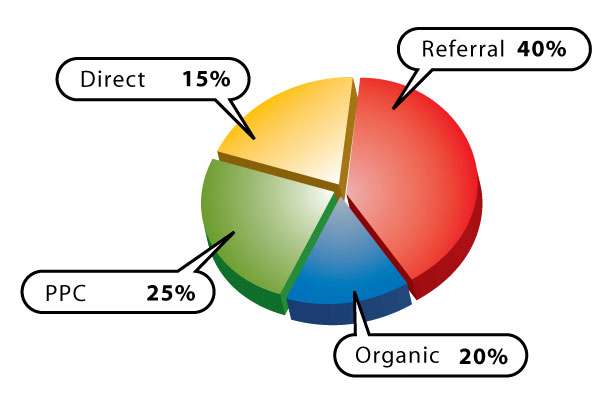
In this article we will evaluate the various types of traffic based on the following characteristics: Duration of generated traffic, Degree of Control, Speed of results and Stability of results. The main goal of this article is not to suggest a single “best” source of traffic. Instead it is to examine the characteristics of the visitors along with the strong & weak points of each type of traffic.

1. Direct Traffic

direct
Direct traffic is made up of visitors who have typed directly the URL of a page or who have found it in the history or bookmarks of their browser. Additionally sometimes we consider as direct traffic, a visit that comes from an Email campaign or from a source that is not possible to be traced. In this article we focus on the first case of direct traffic.
Usually increased direct traffic indicates increased brand awareness. It shows that a large number of usersknow the particular domain, trust it and expect to find useful information or services. In most of the cases they are not new visitors but regular and loyal users.
Duration
Long Lasting
Direct traffic remains high for as long as the topic and the content of the website remains up-to-date.
Degree Of Control
High
Since there are no intermediaries the traffic depends on the quality and freshness of content of the website.
Speed
Very High
Direct traffic is one of the first sources of traffic that a new website receives as a result of word of mouth. Nevertheless the quality and the quantity of the traffic heavily depend on the content of the website.
Stability
Medium-High
The amount of direct visitors that a website receives usually has little unexpected variation but there might be fluctuations due to seasonality.
Visitor Characteristics: Returning Visitors, Regular & Loyal Users.

2. Referring Traffic

up-website-traffic
The Referring traffic is made up of visitors who have clicked on a link of another website and landed on one of your pages. A special type of referring traffic is the one that comes from Social Media and in this article we distinguish it because it has different characteristics.
Increased referring traffic indicates that the website has attractive content and that other webmasters suggest it to their visitors by placing links in their pages. In most of the cases, the pages that receive the most of the links are the ones that are also popular to the users and have great content (Of course there are cases where the increased number of links is a result of a link building strategy). Acquiring links fromrelevant – high traffic websites can drive lots of quality traffic to your website and increase your authority. Those links usually are hard to get and the best way to acquire them is by starting affiliations with other webmasters or by developing innovative services and quality content.
Duration
Varies
(Usually Long Lasting)
Referring traffic remains high for as long as the referring websites continue to receive high traffic and the external pages that contain the links remain popular to the users.
Degree Of Control
Medium
Since the links are placed on external websites, you can’t change their place within the page, their anchor text or their context. Nevertheless in most of the cases you can contact the webmaster for minor changes.
Speed
High
Usually referring traffic is one of the first types of traffic that a new website receives (along with direct traffic). In most of the cases shortly after the launch, the website starts receiving the first incoming links and the referring traffic is increased. Of course the quality and the quantity of the traffic depend on the external websites and on their popularity.
Stability
Medium
The amount of referring visitors that a website receives is usually stable. Nevertheless the number of incoming visitors depends on the traffic of the external websites.
Visitor Characteristics: New Visitors, most of the times Targeted Users.

3. Social Media Traffic

social-media
The Social Media Traffic is the traffic that comes from online communities and social media networks. It is considered a part of Referring Traffic but we usually distinguish it because it has different characteristics. The problem in this distinction is that it is not always clear how to categorize the incoming traffic from particular sources. For example, should we consider the traffic from a forum or from a blog as social media traffic? Our suggestion is to categorize each source of traffic depending on its characteristics.
Increased Social Media Traffic indicates that the website is popular to the users and there is buzz around it. As we discussed in previous articles (12 Tips for developing a Successful Twitter Campaign & 7 tips for launching successful Social Media Campaigns) investing on a social media campaign is something that can drive lots of traffic to your website. Nevertheless have in mind that not all websites or pages become popular on social media since the amount of traffic heavily depends on the nature of the content.
Duration
Short
Each post or message on Social Media usually remains popular for a small period of time. Of course by investing on social media campaigns you increase your popularity and you become a more influential user. As a result more traffic can be driven to your website by staying an active member of the social media networks.
Degree Of Control
Medium
On the one hand you can control the messages that you send, but on the other hand you can’t control what other people say about you.
Speed
Medium
A very interesting high quality website can become popular quite soon on Social Media. Nevertheless in the early beginning of the social media campaign the chances of generating significant traffic are usually low. Lots of time and effort need to be invested in order to be successful.
Stability
Low-Medium
In social media the trends change very fast. Nevertheless by becoming an influential user and by building a community the amount of traffic that you receive from social media can remain stable.
Visitor Characteristics: New & Previous Visitors, Less Targeted Users, High Bounce Rate.

4. Search Engine Traffic (Organic)

2226178289_3f9556c08f
The Search Engine Traffic (Organic) is the traffic that comes from the nonpaid results of the various search engines. Less often we categorize as organic the traffic that comes from directories and yellow pages. In this article we focus on the organic traffic that comes from the search engines.
Increased Search Engine Traffic indicates that the website has launched a successful SEO campaign. This means that the site is well developed, well structured, it has optimized content and it receives lots ofquality links.
Duration
Varies
(Usually Long Lasting)
The duration depends on the techniques that are used (Black-hat techniques do not usually last for long) and on the various algorithmic changes that take place. Large scale algorithmic changes can affect the duration of the SEO campaign.
Degree Of Control
Medium
There are basic principles and rules that if we follow closely, they help us achieve better rankings. Nevertheless, we don’t own the Search Engines, we don’t know always how they work and thus we don’t have full control over their results.
Speed
Low
Usually it takes time until a new website starts receiving a significant amount of Search Engine Traffic. This is because of the fact that the traffic is related to the size of the website and to the authority of the domain.
Stability
Medium
Usually Search Engines avoid making drastic changes in their algorithms and thus the results remain relatively stable (as long as the competition is not increased). Nevertheless every couple of years large scale changes are performed in order to improve the quality of the search results.
Visitor Characteristics: New Visitors, Very Targeted Users.

5. PPC & Paid Traffic

ppc-management-expert
The Paid Traffic is the traffic that comes from online advertisements. There are various types of Paid Traffic such as Pay Per Click (PPC), Paid Inclusion, Pay Per Impression, Paid links etc.
Increased Paid Traffic does not guarantee a successful advertising campaign. Other measures like ROI and Conversion Rates are very important too. Due to the fact that this type of traffic costs, it must be closely monitored in order to improve the effectiveness of the campaign.
Duration
Varies
You can usually keep the campaign for as long as you want.
Degree Of Control
Very High
The major providers support platforms that allow you to control, monitor, filter and measure the results of your campaign very easily.
Speed
Very High
It usually generates traffic directly. Nevertheless the amount of traffic depends on your budget and on your bids.
Stability
High
The amount of visitors that a website receives usually has little unexpected variation but there might be fluctuations due to seasonality.

Conclusion

clipart_of_22448_smjpg_2
So let’s get back to the initial question. Is search engine traffic the best traffic you can get to your website?
Certainly search engine traffic is a great source of traffic since it is an effective way to get New Targetedvisitors at a very low cost. Nevertheless the SEO campaigns can be affected by the algorithmic changes, by the various “best practices” that come and go and by the increasing competition of popular keywords. As a result there is always the possibility of not being able to rank high enough or of losing your competitive rankings overnight.
Have in mind that in order to build a successful SEO campaign you need quality links that at the same time they are the source of referring traffic. Of course in order to get those quality links you need to attractregular visitors and strong supporters who are willing to recommend you to other users in social media or place your link in their websites. Certainly there is always the option of launching a PPC campaign and get fast results but this will cost additional funds and it might not have the expected results if the campaign is not planned carefully.
That’s why my personal favorite is the direct traffic which is always a reliable measure of the number of theregular visitors. My second favorite is the referring traffic (Social Media traffic is included) since quality links from high traffic websites can generate lots of traffic & buzz and also positively affect my SEO campaign. My next favorite source of traffic is the Organic because it generates much targeted traffic and brings lots of new visitors. Finally my least favorite source is Paid Traffic. This is because not only it has the highest cost of all the above but also due to the fact that once the campaign is over, the positive results disappear very quickly. Of course this does not mean that paid traffic is not important for your Promotional Campaign. On the contrary it can be a very handy tool when you want to get results in a very short time. After all, the most important thing in this business is to find the optimal combination of each source and use all the available tools and resources properly.

Google Actions Against Pregnancey Ads

Google Action Against Pregnancy Center Ads Stirs Confusion, But Does Not Signal Preference Or Policy Change


You may have read this week that some paid ads by pro-life oriented crisis pregnancy centers have been removed by Google after pro-choice political advocacy group NARAL claimed creditfor getting the ads banned, as reported by the Washington Post. In reaction, outlets on the pro-life side have cried foul with headlines like “Google Bans Ads From Pregnancy Centers After Lobbying From ‘Pro-Choice’ NARAL” of abortion.
Google’s official response to the issue has been, “We’re constantly reviewing ads to ensure they comply with our AdWords policies, which include strict guidelines related to ad relevance, clarity, and accuracy.  If we find violations, we’ll take the appropriate actions — including account disablings and blacklists — as quickly as possible.”
The fact that is a politically and socially fraught topic has heightened questions about what it all means.
Do Google’s actions mark a policy change on abortion related advertising? Is this an indication the company is taking a political stance on the issue? Are all ads from pregnancy centers banned on Google? Did NARAL tread new ground in “lobbying” Google to remove ads it found misleading?
The answer to all of these questions is, No.
Setting political and social agendas aside, here’s a look at the issue as it pertains to AdWords and the ad review process:
1. Misleading and inaccurate ad copy. While, we don’t know exactly what the ads looked liked, the claim is that the ads in question advertised abortion services even though the advertisers did not in fact offer those services. Making misleading or inaccurate claims in ad copy is a violation Google’s accuracy policy. This is covered under the “Relevance” section of the policy:
Products or services that are promoted in your ad must be reflected on your landing page.
2. Targeting tangentially related keywords. Advertisers can target keywords that may not be directly related, but are relevant, to the products and services being advertised.  This also is covered under the “Relevance” section of the policy:
Your ads and keywords must directly relate to the content on the landing page for your ad. When users see your ad, they should be able to understand what kind of product, service, or other content they’ll find on your site.
Some of the reporting on this matter has claimed Google banned crisis pregnancy groups from advertising altogether, while other said they were no longer allowed to advertise on “abortion clinic” related keywords.  Neither is true.  A clinic that does not offer abortion services can still buy and advertise on “crisis pregnancy center” and “abortion clinic” related keywords. The advertisers can promote the abortion alternative services, adoption or pre-natal care they offer, for example.
These ads were running this morning.
In the first two ads, it could be argued there language like “Real Answers Real Help” and “Is it Safe? What Are The Risks?” is misleading and that users should expect to find a balanced, objective presentation of both sides of the discussion rather than only material from pro-life advocates. Google’s actions have affected only ads that made inaccurate claims about services offered.
google-abortion-clinic-search-crisis-pregnancy-clinics
3. Google’s policy on Abortion advertising. Google has long had a specific policy on Abortion related advertising, which differs in certain countries based on restrictions imposed in those regions.
Google AdWords doesn’t allow ads related to abortion that use violent language or gruesome imagery. In certain countries, we allow ads for abortion or related services. Ads for abortion or related services won’t show on partner websites who don’t accept this type of content or in countries where this content isn’t allowed.
The policy has not changed as a result of the actions Google took this week.
4. The Ad Review Process. Now, let’s talk about the ad review process. Google has both automated and manual systems in place for reviewing and taking action on ads. Advertisers and users can flag and report ads they believe are in policy violations to Google for manual review. Last year, Google said it blocked more than 350 million bad ads last year.
That said the process is far from perfect. Many advertisers can cite cases in which ads they believe clearly violate AdWords’ policies continue to run despite being flagged multiple times.
Google finally responded to complaints about fraudulent pharmacy ads after a federal investigation and $500 million fine was levied on the company. Yet, that accusations that the company isn’t doing enough continued last year. After reporting on flagrant violations in the tech support sector last year, we saw a dramatic clean up in the ads on those search terms. NARAL apparently had been flagging these types of ads as misleading and inaccurate and became vocal about getting Google to take action.
Today, ads for crisis pregnancy centers continue to display on Google search results. None of the ads for these centers suggest abortion services are offered, however. Do notice, however, that just as crisis pregnancy centers are still running ads on “abortion clinic” keywords, here we see an example of the “Safest Private Abortion” option being advertised on what many consider a pro-life search query.
Crisis Pregnancy Center Ads on GoogleYes, Google took action, and it may have required vocal pressure from NARAL, but I don’t see any indication Google’s action were politically motivated or signal a shift in how and what ads are reviewed.

Sunday, 11 May 2014

SEO Effective Tools

SEO Tools


Check your blog page load time, Google Page Rank, backlinks, broken links, reciprocal link and meta tags right here on Blogger Sentral. Just enter your domain or your web page URL in the appropriate text box and click Check! button. Results will be displayed below the text box.
All SEO tools below are provided and hosted by iWEBTOOL, except for Google Page Rank checker.

1. Speed tester

Check web page size and load time.
Your domain/web page:
(eg. www.bloggersentral.com)
For a more detailed page analysis, try Pingdom.

2. Rank checker

Check Google Page Rank of your domain or web page. Result will be shown in a new window.
Your domain/web page:
This page rank checker is powered by Page Rank Checker
Check backlinks to your domain or web page.
Your domain/web page:
(eg. www.bloggersentral.com)
Check whether your link partner is still linking back to your site.
Your domain: (You must include http://)
Your partner's URL:
Check for broken links in your web page.
Your web page URL:
(eg. http://www.bloggersentral.com/2010/05/my-web-page.html)

6. Meta tag checker

Extract your web page's meta information and tags.
Your web page:http://
(eg. www.bloggersentral.com/2010/05/my-web-page.html)